Security is no longer a technical concern confined to IT departments. It is a board-level responsibility. As organizations digitize operations and expand remote access, they handle increasingly sensitive data. Traditional authentication methods are no longer sufficient to protect it.
This is why many executives search for a clear answer to a simple but critical question:
What are the types of biometric authentication, and which one is right for our organization?
In simple terms, biometric authentication confirms identity using physical or Behavioral traits unique to an individual. These traits create a direct link between the person and the action being approved. However, biometric methods vary significantly in strength, reliability, and suitability. The right choice depends on the required level of assurance, regulatory context, and operational risk.
This guide is written to help decision-makers understand:
- A Complete Overview of All Biometric Authentication Types
- How each method works behind the scenes
- Their advantages and limitations
- Where each method fits within real organizational environments
- Why expert guidance is essential before making a final decision
At ComSignTrust, we work with regulated industries, enterprises, and public sector organizations across the UK. This article reflects the questions leaders ask us before deploying biometric security at scale.
What Are Biometric Authentication Types?
Biometric authentication methods fall into two broad categories:
- Physiological biometrics
Based on physical characteristics, such as fingerprints or facial features.
- Behavioral biometrics
Based on patterns in Behavior, such as typing rhythm or gait.
Each method serves a different purpose. Some prioritize speed and user convenience. Others focus on high assurance, legal validity, and compliance.
Let’s examine each type in detail.
Physiological Types of Biometric Authentication
1. Fingerprint Recognition
Definition
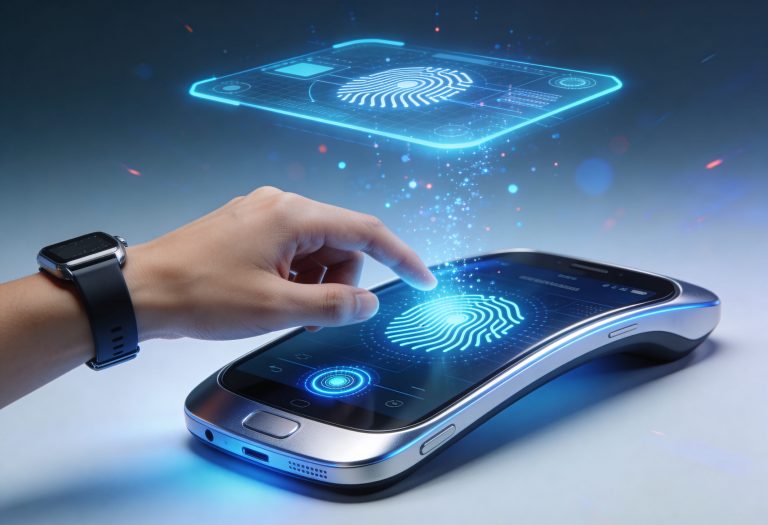
Fingerprint recognition identifies a person by analyzing the unique ridge patterns on their fingertips.
How it works in the backend:
- The system captures a fingerprint image from the user.
- Key fingerprint features, known as minutiae, are identified and extracted.
- These features are converted into a mathematical template and stored securely.
- During authentication, the new template is compared with the stored reference to verify identity.
Advantages
- Mature and widely adopted technology
- Fast authentication
- Cost-effective for large deployments
- Familiar to users
Disadvantages
- Can be affected by worn or damaged fingerprints
- Not suitable for environments requiring contactless access
- Moderate resistance to spoofing unless combined with liveness detection
Best suited for
This method is commonly used for employee access control and device authentication. It is also well-suited to low-to-medium risk workflows, where speed and ease of use are important.
2. Facial Recognition
Definition
Facial recognition verifies identity by analyzing facial structure, geometry, and unique visual features.
It compares these features against a stored reference to confirm the user’s identity.
How it works in the backend
- The camera takes a clear image of the user’s face.
- AI algorithms analyze key facial features and convert them into a secure biometric template.
- The system checks for real human presence to block photo or video spoofing attempts.
- The captured facial data is compared with stored records to confirm identity.
Advantages
- Contactless and user-friendly
- Suitable for remote authentication
- Scales well for large user bases
Disadvantages
- Sensitive to lighting conditions without proper calibration
- Higher privacy considerations under UK GDPR
- Requires robust liveness controls
Best suited for
Remote onboarding, digital signing, and identity verification for regulated services.
The biometric technologies below represent the highest tier of security
Iris Recognition
Definition
Iris recognition uses the unique patterns in the coloured ring of the eye.
How it works in the backend
High-resolution imaging captures iris patterns, which are encoded into encrypted templates. Matching accuracy is extremely high.
Advantages
- Very high accuracy
- Low false acceptance rates
- Stable biometric over time
Disadvantages
- Requires specialized hardware
- Less familiar to users
- Higher deployment cost
Best suited for
High-security environments, critical infrastructure, government or defence-related access.
Retina Scanning
Definition
Retina scanning analyzes the blood vessel patterns at the back of the eye.
How it works in the backend
Low-intensity infrared light maps retinal blood vessels, producing an extremely precise biometric template.
Advantages
- Extremely high accuracy
- Very difficult to spoof
Disadvantages
- Intrusive user experience
- Expensive hardware
- Rarely used in commercial environments
Best suited for
Ultra-high security scenarios where usability is secondary to assurance.
Vein Recognition (Palm or Finger Vein)
Definition
Vein recognition authenticates users based on unique vein patterns beneath the skin.
How it works in the backend
Near-infrared light detects vein patterns, which are converted into encrypted templates.
Advantages
- Contactless and hygienic
- Internal biometric makes spoofing difficult
- High accuracy
Disadvantages
- Requires dedicated scanners
- Higher cost than fingerprint systems
Best suited for
Financial services, healthcare, controlled access environments.
Operational Biometric Authentication Methods
Hand Geometry and Palm Print Recognition
| Biometric Method | Description |
| Hand Geometry | Hand geometry measures the physical shape, size, and structure of an individual’s hand. In the backend, sensors capture key hand dimensions and compare them against stored biometric profiles. This method is simple, durable, and performs reliably in industrial or operational environments. However, it offers lower accuracy than modern biometric technologies and is not suitable for high-risk authentication scenarios. It is most commonly used for time and attendance systems and controlled workforce access. |
| Palm Print Recognition | Palm print recognition analyzes the lines, textures, and surface patterns of the palm using high-resolution imaging. These detailed features are converted into biometric templates for secure matching. Due to the larger number of data points available, this method provides higher accuracy than fingerprint recognition. However, it is less widely adopted and requires specialized hardware. Palm print recognition is therefore best suited for high-assurance access systems where fingerprint authentication alone does not provide sufficient security. |
While physiological biometrics rely on physical characteristics, they do not represent the full scope of modern biometric security.
Behavioral Types of Biometric Authentication
1. Keystroke Dynamics
Definition
Keystroke authentication identifies users based on typing rhythm and patterns.
How it works in the backend
The system analyzes typing speed, pressure, and timing, creating a Behavioral profile.
Advantages
- Continuous authentication
- No additional hardware required
- Non-intrusive
Disadvantages
- Behavior can change under stress or fatigue
- Lower accuracy when used alone
Best suited for
Continuous monitoring, fraud detection, and layered security models.
2. Signature Recognition (Dynamic)
Definition
Signature recognition analyzes how a signature is written, not just its appearance.
How it works in the backend
The system captures stroke order, pressure, speed, and motion dynamics.
Advantages
- Familiar to users
- Useful in document signing workflows
- Strong evidential value when combined with certificates
Disadvantages
- Behavioral variation over time
- Requires compatible input devices
Best suited for
Digital signing, legal workflows, regulated agreements.
3. Voice Recognition
Definition
Voice recognition authenticates users based on vocal characteristics.
How it works in the backend
Voice samples are converted into biometric voiceprints using frequency and pattern analyzis.
Advantages
- Natural user experience
- Suitable for call centers and remote access
Disadvantages
- Affected by background noise
- Vulnerable without liveness detection
Best suited for
Customer service authentication, remote identity checks.
4. Gait Recognition
Definition
Gait recognition analyzes how a person walks.
How it works in the backend
Sensors or cameras capture movement patterns and compare them to stored profiles.
Advantages
- Passive authentication
- Difficult to consciously mimic
Disadvantages
- Environmental sensitivity
- Limited commercial maturity
Best suited for
Supplementary security, research environments.
5. Behavioral Biometrics (General)
Definition
Behavioral biometrics combine multiple Behavioral signals such as mouse movement, navigation patterns, and interaction habits.
How it works in the backend
AI models continuously analyze Behavioral data to detect anomalies.
Advantages
- Continuous risk assessment
- Invisible to users
Disadvantages
- Requires data volume to stabilise accuracy
- Best used alongside other methods
Best suited for
Fraud prevention, adaptive authentication.
6. Multimodal Biometric Authentication
Definition
Multimodal systems combine two or more biometric methods.
How it works in the backend
Multiple biometric inputs are verified together to increase assurance.
Advantages
- Highest security
- Reduces false positives and negatives
Disadvantages
- Higher complexity and cost
Best suited for
Regulated industries, high-risk transactions, enterprise-grade security frameworks.
7. DNA Biometrics (Emerging)
Definition
DNA authentication uses genetic information to confirm identity.
Status
Currently impractical for real-time authentication due to privacy, ethical, and processing constraints.
Best suited for
Forensic and research contexts, not commercial deployment.
Why No Single Biometric Fits Every organization
This list often creates confusion for leaders. The question is which advanced biometric solution fits your risk profile, regulatory environment, and operational reality.
This is where organizations frequently pause, and rightly so.
It is at this point that many organizations hesitate. The technology exists. The options are numerous. Yet the consequences of choosing incorrectly can be significant.
For CEOs and senior decision-makers, the question shifts from what is available to what is appropriate.
Matching Biometric Types to organizational Needs
Low to Medium Risk Environments
Examples include internal systems, employee access, and routine approvals.
Suitable biometric methods
- Fingerprint recognition
- Facial recognition
- Behavioral biometrics
- Keystroke dynamics
These methods prioritize speed and usability, while still providing a meaningful security upgrade over passwords.
Regulated and Compliance-Sensitive Environments
Examples include financial services, legal workflows, healthcare, and government-adjacent services.
Suitable biometric methods
- Facial recognition with liveness detection
- Dynamic signature recognition
- Multimodal biometric authentication
- Digital signatures supported by biometric verification
Here, identity assurance and auditability are non-negotiable. Biometric authentication must integrate seamlessly with compliance frameworks.
High-Risk and High-Value Operations
Examples include critical infrastructure, sensitive transactions, and legally binding approvals.
Suitable biometric methods
- Iris recognition
- Vein recognition
- Multimodal authentication combining biometrics with cryptographic certificates
These environments prioritize evidential strength, tamper resistance, and legal defensibility.
The Compliance and Legal Dimension in the UK
In the UK, biometric authentication must be deployed with careful attention to:
- UK GDPR
- Data minimisation principles
- Explicit user consent
- Secure storage and processing
- Clear audit trails
Biometric data is classified as special category personal data. This alone places an obligation on organizations to adopt stronger governance, not weaker tools.
This is where biometric authentication must connect to trusted digital identity and signing frameworks, not operate in isolation.
Practical Deployment Contexts
One of the most common gaps in biometric discussions is the absence of real-world context. Technology decisions are not made in isolation. They are made within specific environments.
In practice, biometric authentication is already embedded across multiple sectors:
- Travel and border control
Facial recognition is widely used in automated border systems to verify identity efficiently while maintaining security standards.
- Banking and digital financial services
Fingerprint and facial authentication support secure account access, transaction approval, and fraud prevention.
- Workplace and enterprise access control
Biometrics replace or strengthen passwords for workstation login, remote access, and controlled physical environments.
These examples demonstrate a critical point. Biometric technologies succeed when they are deployed where usability, security, and context align. This principle underpins every recommendation we make.
Privacy, Ethics, and Regulatory Expectations
Biometric data is inherently sensitive. Under UK GDPR, it is classified as a special category of personal data. This classification carries heightened responsibility.
organizations must:
- Justify the use of biometric data
- Ensure strong security controls
- Minimise data collection
- Maintain transparency with users
- Provide clear governance and auditability
Failure in any of these areas introduces legal, reputational, and operational risk.
This is why biometric authentication should never be implemented as a standalone technical feature. It must sit within a structured identity and trust framework that supports compliance by design.
Error, Failure, and Real-World Limitations
Another area often overlooked in high-level content is how the different types of biometric authentication perform in real operational environments.
All biometric systems carry limitations, including:
- false acceptances and false rejections
- environmental sensitivity, such as lighting, dirt, or sensor quality
- changes in physical characteristics over time
Professional implementations mitigate these risks through:
- appropriate biometric selection
- fallback authentication methods
- layered or multi-factor approaches
- continuous monitoring and adjustment
Expert Guidance on Biometric Authentication
Expert evaluation typically considers:
- The level of assurance required
- Regulatory exposure
- User environment and scale
- Integration with existing identity systems
- Long-term manageability
In many enterprise environments, fingerprint and facial recognition emerge as the most practical options. They are mature, widely supported, and integrate effectively with identity and access management systems.
This is precisely ComSignTrust’s area of expertise.
How ComSignTrust Approaches Biometric Authentication
ComSignTrust does not attempt to implement every biometric modality available. Instead, it concentrates on biometric technologies that deliver measurable value in real organizational environments.
Through solutions such as BioLogon and integrated identity platforms, ComSignTrust supports:
- Fingerprint authentication
- Facial recognition
- Integration with Active Directory and enterprise systems
- Alignment with digital signing and certified trust services
Biometrics are implemented as part of a broader security ecosystem. This ensures that identity verification, authentication, and legally recognised digital actions operate together rather than in isolation.
This approach reduces complexity, strengthens compliance, and improves adoption.
Biometric Authentication in Digital Signing and Identity Assurance
One of the most effective applications of biometrics is within electronic and digital signing workflows.
When combined correctly, biometric authentication:
- Strengthens proof of signer identity
- Reduces repudiation risk
- Enhances evidential value in disputes
- Supports remote and high-value transactions
For regulated agreements, biometrics can be used as an additional authentication layer before issuing or activating:
- Advanced Electronic Signatures
- Qualified Electronic Signatures
- Certified digital certificates
This alignment is critical for organizations that cannot afford ambiguity.
What This Means for You
If you are evaluating biometric authentication, the objective is not to adopt the most advanced or novel technology. It is to adopt the most appropriate one.
The right choice delivers:
- security without friction
- compliance without uncertainty
- scalability without re-engineering
- confidence without complexity
Making that choice requires context, experience, and a clear understanding of how biometrics fit into your wider identity and trust strategy.
Talk to an expert before making a decision. Contact us today!
The right guidance today prevents costly corrections tomorrow.
FAQs
Is biometric authentication more secure than passwords?
Biometric authentication is generally more secure than passwords. It links access to a physical or Behavioral trait rather than a shared secret. This makes it harder to steal or reuse. However, it works best when combined with another factor. On its own, it should not be treated as a complete security solution.
What happens if my biometric data is stolen or hacked?
Biometric data cannot be easily changed. This makes a breach more serious than a password leak. If biometric templates are compromised, the risk can persist over time. For this reason, strong protection measures are essential. Responsible systems reduce impact by storing encrypted templates rather than raw biometric images.
What types of biometric authentication are available?
Biometric authentication includes physical and Behavioral methods. Common physical methods include fingerprint, facial recognition, and iris scanning. Behavioral methods analyze patterns such as typing rhythm or movement. Each type offers different levels of accuracy, convenience, and risk. The right choice depends on the use case and risk level.
How is biometric data protected under UK law (GDPR/ICO)?
Under UK GDPR, biometric data used for identification is classed as special category data. This means it receives stronger legal protection. organizations must show a clear lawful basis and demonstrate necessity. They must also apply strict security controls, limit data use, and carry out risk assessments where required. The ICO actively enforces these obligations.